Why AI Prefers the Number 7 and Why You Should Care
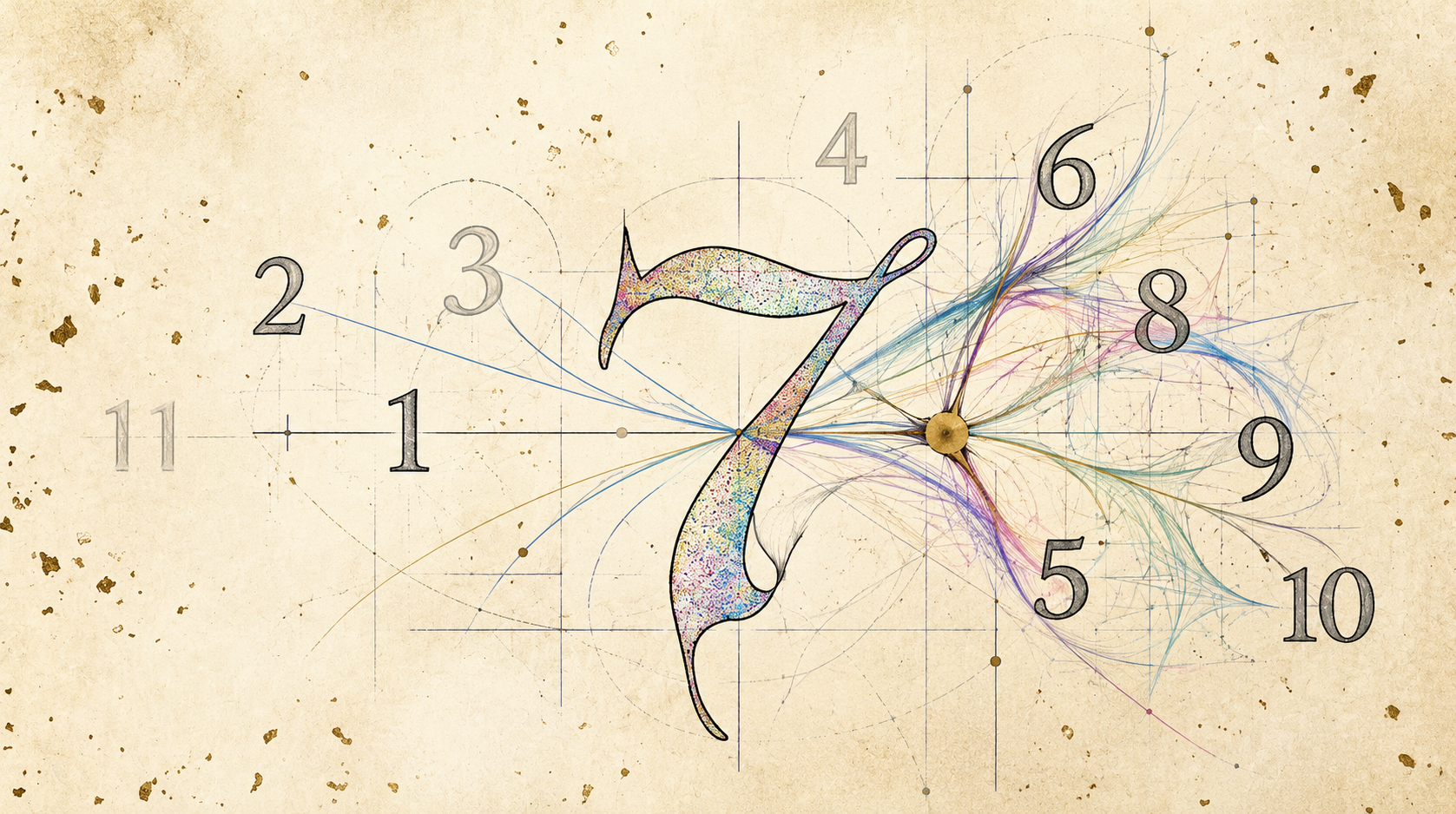
Ask your favorite AI to pick a number from 1 to 10. Is it 7? Try another AI. Again, 7?
It's October 2026, and we're witnessing this curious phenomenon. Let's enjoy it while it lasts. It may not last much longer. But the underlying mechanics will.
So, what's the deal with 7?
Seven is also the number we humans tend to pick when asked to name a random number. Why? Because, unlike 1 or 5, it feels random to us. We tend to avoid extremes and numbers that seem too obvious, while 7 feels less predictable. This is one explanation for the pattern, explored in Kubovy and Psotka's study [1] and this Veritasium video [2].
AI models (LLMs) also strongly favour 7 when asked to pick a number between 1 and 10. They learn patterns from human-generated text, so perhaps it's not so surprising that they reproduce a human preference.
But why should we care?
1. The diversity bottleneck
Imagine there are ten restaurants, all worth visiting and matching our preferences. We ask AI for a recommendation, and it suggests the same one to all of us.
Of course, humans have preferences too. One person might always recommend the same restaurant. But across many people, we'd expect all ten to get some recommendations, even if some are mentioned more often than others. However, if AI systems keep recommending the same top options, the alternatives might disappear from view. Research on AI-generated writing suggests that its outputs can be less diverse than human writing. [3]
Google search already had a similar effect. The top result attracted more attention, but at least we could see a list of alternatives, click through, and form our own opinions. With an AI assistant giving us one confident recommendation, the other options might never even enter the picture.
It can become a self-fulfilling prophecy: the restaurant gets more AI recommendations, attracts more customers, and generates more reviews, which lead to even more recommendations. The cycle reinforces itself.
Scale this up to jobs, businesses, and ideas, and the same cycle could concentrate attention and opportunities around a few winners, leaving equally worthy alternatives behind.
More fundamentally, if we treat AI recommendations as the truth, we risk letting AI define what is right, normal, or acceptable behaviour.
How we can better use AI: Asking for alternatives and exploring different perspectives can help us see beyond the most obvious recommendations.
2. Anchoring: The power of the first answer
There's another, more personal effect. The first answer we receive can influence what we consider next.
Even if nine other restaurants are equally good, the recommended one becomes our reference point. We might stop searching, compare every alternative against it, or simply go with the suggestion because it's convenient.
This is known as anchoring: our judgments are influenced by the first piece of information we encounter.
This is also why it's sometimes worth letting others form their own opinions before sharing yours. Once we reveal our view, it can become an anchor for how they see things.
AI doesn't need to force us into a decision to influence it. By presenting one option first, it can influence our attention and choices.
How we can better use AI: Having our own shortlist before consulting AI can help prevent its first suggestion from becoming our reference point.
Look beyond the 7
Of course, the number 7 is just one curious example. But it raises a bigger question: what happens when we increasingly rely on similar systems to help us decide what to see, think about, and choose?
AI can open up possibilities. But if we rely too heavily on its first answer, we might never discover what lies beyond it.
Further reading
[1] Kubovy, M., & Psotka, J. (1976). The Predominance of Seven and the Apparent Spontaneity of Numerical Choices. Journal of Experimental Psychology: Human Perception and Performance, 2(2), 291–294.
[2] Why Is This Number Everywhere? by Veritasium.
[3] Moon, J., Green, J., & Kushlev, K. (2025). Homogenizing Effect of Large Language Models on Creative Diversity.
[4] Is AI Turning Us All into the Same Person? by Sandra Matz (TED).
Thanks to my friend Marian for our discussion and for sharing the Veritasium video.